
Ask the Physio Files · No. 1
Cruciate Ligament Injury in Dogs
One of the most common causes of lameness in dogs — what the cruciate ligament does, why it ruptures, and how it’s treated.
Holly Gibson • HLG Veterinary Physiotherapy • 5 min read
This is the first in my series of Ask the Physio Files, where I’m looking at a condition that’s one of the most common causes of lameness in dogs — cruciate ligament injury. Here’s what it is, why it happens, and what can be done to help.
What is the cruciate ligament?
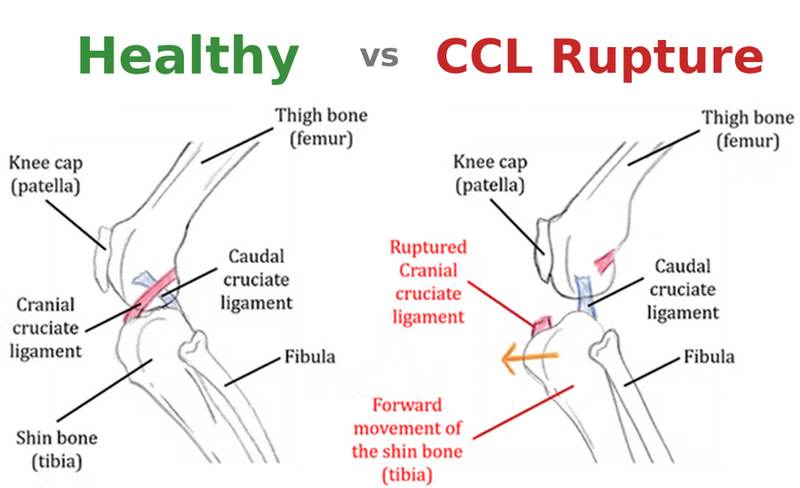
Ligaments are bands of tough connective tissue that connect bones and hold joints together. Inside a dog’s knee — the stifle joint — two cruciate ligaments cross over to form an X: the cranial cruciate ligament and the caudal cruciate ligament. When injury strikes, it’s almost always the cranial cruciate ligament (CCL) that ruptures.
Dogs and people share very similar anatomy here — the CCL is the equivalent of the ACL (anterior cruciate ligament) in humans. It sits inside the knee joint and forms the attachment between the thigh bone (femur) and the shin bone (tibia), letting the knee swing back and forth like a hinge while limiting side-to-side movement.
What does the CCL do?
The CCL has three main jobs:
- Stop the shin bone (tibia) sliding forward relative to the thigh bone (femur).
- Stop the knee (stifle) from over-extending.
- Stop the shin bone rotating inwards.
The bones of the knee don’t interlock, so the joint relies entirely on its ligaments to stay stable — which is exactly why the CCL matters so much.
Why does the CCL rupture?
Most of the time, the ligament ruptures because it has slowly degenerated and weakened over time. It first stretches or partially tears, and with continued use the damage worsens until it finally gives way completely — and that rupture can happen during something as ordinary as a walk.
Several things are thought to raise the risk of this degeneration:
- Breed & genetics. It’s more common in Newfoundlands, Bull Mastiffs, Rottweilers, Golden and Labrador Retrievers, Boxers and West Highland White Terriers.
- Conformation. A dog’s shape and structure plays a part — for example, very upright limbs.
- Body weight. As with any joint problem, dogs carrying extra weight rupture their CCL more often.
Once one CCL has ruptured, the other often follows — around 30–50% of dogs injure both within 1–2 years. That’s why careful rehabilitation and a safe, gradual return to exercise is so important.
Less commonly, the CCL ruptures suddenly through trauma — usually a twist of the knee when a dog is running and makes a sharp change of direction.
What’s happening inside the joint?
The science bit
Once the CCL has ruptured, it can no longer do its job. When the dog puts weight on the leg, the thigh bone slides backwards and down the slope of the shin bone — so the shin bone effectively moves forward relative to the thigh bone, exactly the movement the CCL is meant to prevent. This creates abnormal forces in the joint, and those forces cause pain.
Your vet can check for this with the cranial drawer test, which reveals that abnormal forward movement of the shin bone and confirms the knee has become unstable.
The knee also holds the meniscus — a pad of cushioning cartilage. It is often damaged at the same time as the cruciate ligament, and is frequently the cause of any clicking you can hear. Where it is torn, it is usually checked and treated during the same surgery.
Signs to look out for
Because ruptures can be partial or complete, the signs vary from dog to dog. Common ones include:
- Hind-limb lameness (a limp)
- Joint pain
- Joint swelling
- Difficulty rising and jumping
- Clicking noises in the joint
- Stiff, “pottery” movement
- In severe cases, unable to get up at all
With a partial rupture you may notice your dog improves after rest and worsens during or straight after exercise. Most partial ruptures go on to rupture completely over time, as the ligament wears down with repeated use.
Treatment
A small number of cases can be managed without surgery. This might suit smaller dogs (under about 15kg), or a dog who can’t safely be put under anaesthetic. Conservative management includes restricted exercise, weight management to keep an ideal weight, pain relief, and physiotherapy and hydrotherapy to strengthen the structures that support the joint.
Most cases, though, need surgery to stabilise the knee and stop the pain. The options either replace the ligament or change the structure of the knee so the CCL is no longer needed — the two most common being the TPLO (tibial plateau levelling osteotomy) and the TTA (tibial tuberosity advancement). After surgery, rest is essential, with exercise reintroduced gradually over time.
How can physiotherapy help?
Physiotherapy is an essential part of both conservative and post-operative care. Early on, I focus on easing the pain and swelling seen in the first stages, using techniques such as massage and cold therapy. From there, I work with owners on a gradual, safe return to exercise — slowly building up walks and introducing therapeutic exercises.
The goal is to strengthen the muscles around both knees for support — and hopefully help protect the second CCL — while restoring movement in the joint, which is often restricted, especially after a spell of crate rest following surgery.
Prognosis
Dogs with a cruciate injury will develop some osteoarthritis in the joint over time, but this can be managed well. Post-operative recovery takes at least three months with exercise restricted — and the outlook is good.
Frequently asked questions
Can it get better without surgery?
A small number of cases can be managed without surgery, usually smaller dogs under about 15kg, or dogs who can’t safely have an anaesthetic. This means restricted exercise, weight management, pain relief and physiotherapy. Most dogs, though, do best with surgery to stabilise the knee and give the most reliable long term result.
Will the other back leg go too?
It’s a real possibility. Around 30 to 50% of dogs injure their other CCL within one to two years of the first injury. Careful rehabilitation and a gradual, controlled return to exercise are the best ways to help protect the second knee.
How long is the recovery?
Recovery after surgery generally takes at least three months, with exercise carefully restricted at first and then gradually built back up. Around 90% of dogs go on to return to normal activity.
Is my dog in pain?
A ruptured cruciate creates abnormal forces in the joint, which are painful. Common signs are limping, stiffness, difficulty rising or jumping, and reluctance to exercise. If you’re worried, please speak to your vet.
Does breed or weight matter?
Yes, both play a part. Breeds such as Newfoundlands, Bull Mastiffs, Rottweilers, Golden and Labrador Retrievers, Boxers and West Highland White Terriers are more commonly affected, and dogs carrying extra weight are more likely to rupture their CCL, since it puts more strain on the joint.
Think your dog might have a cruciate injury?
Physiotherapy can make a real difference — both alongside conservative management and after surgery. Get in touch and I’ll be glad to help.
F HLG Veterinary Physiotherapy
That’s the first of my Ask the Physio Files, on cruciate ligament injury. If you have any other questions about this condition, I’m always happy to help where I can. Keep an eye out for next month’s post on another common condition — and do drop me a message if there’s anything I can do to help your animals.
— Holly
This fact file is for general information for dog owners and isn’t a substitute for veterinary advice. If you’re worried about your dog, please speak to your vet.